What Your Body Has Been Trying to Tell You
The Body Remembers
This past weekend, I had one of the most meaningful training experiences of my career.
I spent four days with Betsy Polatin and a group of Alexander Technique teachers diving deep into the intersection of Alexander's discoveries and trauma. It was a lot to sit with. AND it was also illuminating.
Here is the big idea: your body holds on to things. Maybe that’s not earth-shattering news - but let’s read that again.
Your BODY holds on to things. Not your brain… your body.
Researcher Bessel Van der Kolk wrote that the body keeps the score. And in my work — session after session, year after year — I see exactly what that means.
You may recognize this in your own life. A tightness in your shoulders that never fully goes away. A jaw that clenches without you noticing. A low back that flares under stress, not just under load. A voice that feels tight and won’t produce sounds the way you want. Sometimes these patterns have a story behind them. One your body is still holding, even when your mind has moved on.
Tension Is Not the Enemy
In the studio, I work with people who carry patterns like these. Using gentle, co-regulating touch (or sometimes just using words), I help guide the nervous system toward more ease. Often, this leads to real relief — less pain/tension, more freedom in movement and sound, and sometimes a shift in how a person feels emotionally, too.
But here is something important.
Ease is not collapse. Ease is efficient coordination. And noticing is where it begins.
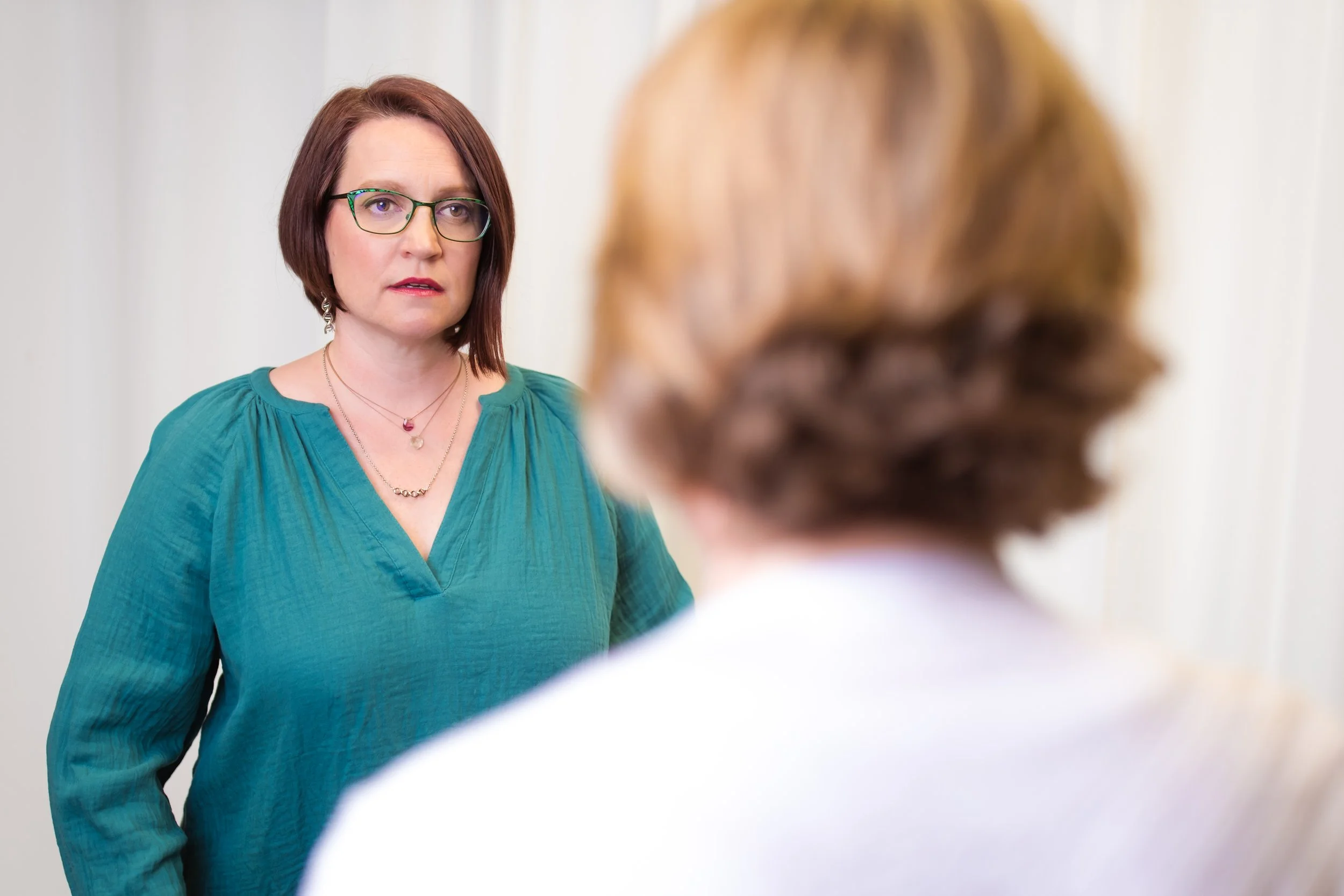
When I place my hands on someone's neck, head, or shoulders, I'm not trying to push the tension away. I'm listening to it. Tension is protective. The body is intelligent. What we're doing together is creating the conditions where the nervous system feels safe enough to let go — on its own terms.
When Patterns Won't Budge
Some patterns are stubborn.
Not because a person isn't trying or open to change. Not because they lack discipline or awareness. But because the pattern was created to keep them safe during a difficult time. The nervous system locked it in. And it doesn't release easily — because to the body, releasing it can feel like losing protection.
This is where somatic, trauma-informed tools become essential.
With these tools, we don't dig up old stories or ask a person to relive painful experiences. The work happens through the body. We gently support the nervous system to feel safe enough to reorganize. And when it does, the body (and often the voice) becomes more free. The mind often follows.
Consider for a moment: what if the pattern you've been trying to change isn't a flaw? What if it was once a very good solution?
This Is Not New Territory — It's a Deepening
I want to be honest with you about something.
Trauma-informed Alexander work is not new to my practice. Years ago, one of my own teachers helped me process trauma that surfaced during my AT teacher training. That experience showed me — up close, in my own body — just how powerful this work is. And how necessary it is to bring that awareness into sessions with clients.
I've been doing that from the beginning.
What this recent training offered me was a deepening. New tools. New language. A clearer map for understanding when we are working with Alexander's discoveries, and when we have moved into the territory of somatic and trauma-informed practice.
It also gave me something practical: many opportunities to try these tools with other participants, to notice when we need to “pump the brakes”, to slow down, to stay with a sensation and awareness and highlight it. And then, to create space for the nervous system to regulate and find safety again. And through that - often with a gentle touch - someone might move from "I just can't seem to do that" to enter a curious state where the inkling of a new possibility arrives.
There may be a reason for that resistance. And now I have more ways to meet it with care.
We don’t have to direct around it, avoid it, or look to quickly correct it. But instead we can allow it the space to soften, melt, and let go.
What This Means for You
Your body has been working hard to protect you.
That protection made sense at the time. It may still be serving a purpose you haven't fully identified yet. And it can be met — not with force, not with correction, but with awareness and a nervous system that gradually learns it is safe enough to reorganize.
That is the work.
Notice what you're holding. Consider what might shift if your nervous system felt more supported. Ask yourself what ease — real ease, not collapse — might feel like in your body.
If any of this resonates, I'd love to keep this conversation going.
Want More?
I'll be sharing more of these insights in my newsletter — what I'm learning, what I'm seeing in sessions, and how this work continues to open up new possibilities for the people I work with.
If this feels like something you need in your inbox, subscribe below. There's more good stuff on the way.
Subscribe to the Newsletter — link here
Amy Mushall is the founder of Your Instrumental Body and creator of The Coordination Bridge: Where Safety Meets Movement. She works with clients in the Alexander Technique studio and online.