
Teen Voice Lessons
for Serious Teen Performers
Online & in Colorado Springs
Book a Free Discovery Call
for you and your teen, 20 minutes, no pressure.
Serious teen performers don't all seek lessons for the same reasons.
This studio doesn't teach them all the same way.
But a few patterns show up again and again — see if one sounds like you, or your teen.
The pressure pattern.
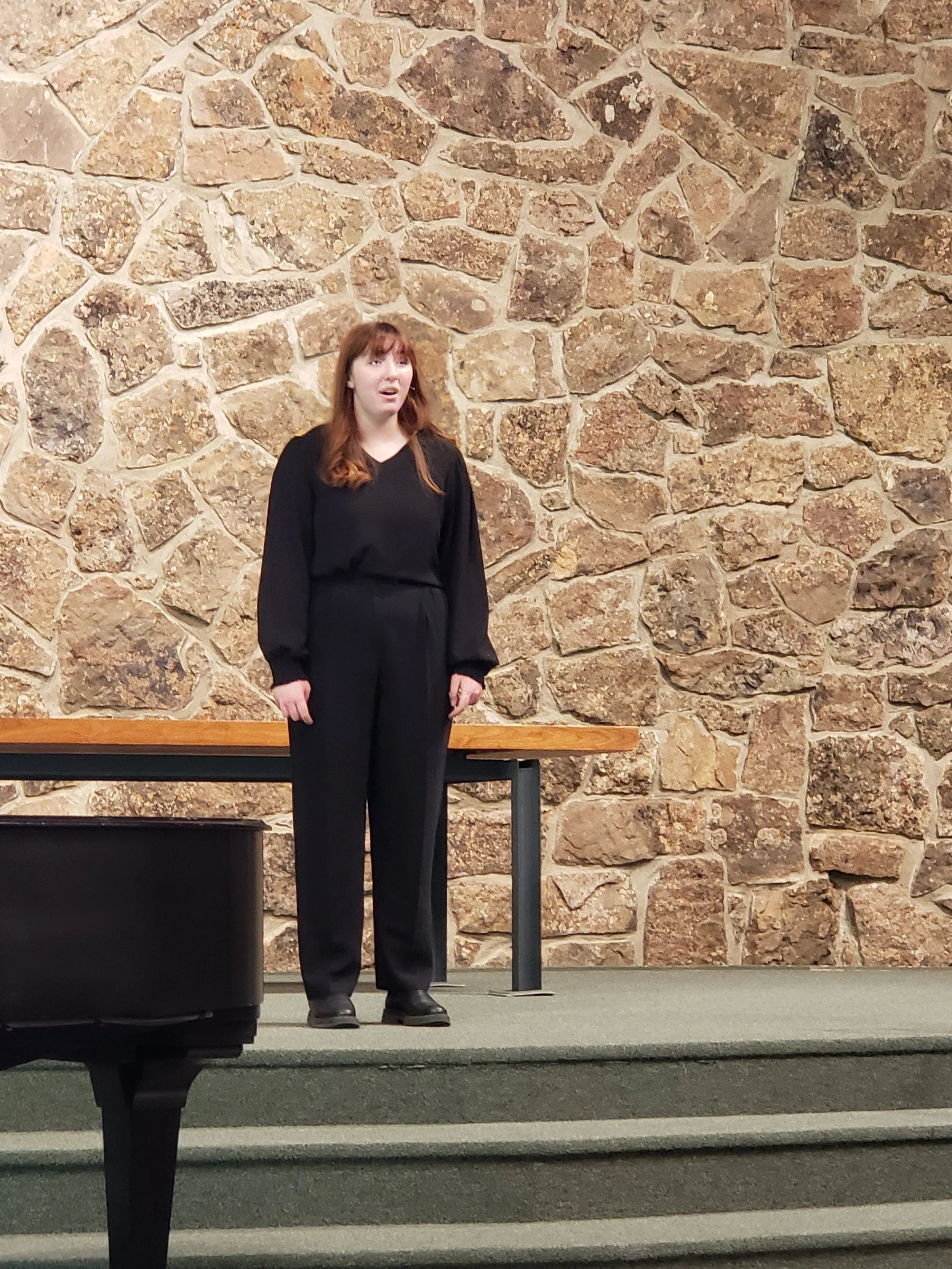
She's already good, and she knows it, and she pushes through anyway — because that's always worked, until tech week arrives and the voice that was fine in the practice room isn't there anymore. A voice that disappears under pressure is usually compensating for tension nobody's shown her how to release.
The big break pattern.
She can belt her face off, but as soon as she gets to hear break, she loses all of the power in her sound. She feels very insecure using half of her voice, and she feels like she can’t sing when it happens.
The younger, messier pattern.
Already booking real roles, right in the middle of voice change, discovering vibrato and mix for the first time — and half-convinced something's gone wrong when it just feels unfamiliar.
The no-crisis pattern.
A talented, confident singer years into choir, equally at home in classical, jazz, and musical theatre — headed toward college without needing to know yet whether that means an opera stage or a Broadway one.
Whichever one sounds like you, the same approach holds underneath: this isn't about being told to relax, or to want it less, or to pick a lane before you're ready.
It's about giving the body underneath the ambition enough support that it stops costing you the very thing you're chasing.
We don't sing in a bubble — your voice is a direct reflection of how your instrumental body is functioning.
For a lot of teens, that shows up as the same worry pulling in two different directions.
Some singers over-effort — pushing volume or emotion that isn't there yet, because trying hard feels safer than trusting it.
Others go quiet and breathy, curling inward, trying to take up less space in the exact moment they're meant to be seen.
Both are the body managing the same fear of being watched, just in opposite directions. The same strategies that ease that fear here are the ones that end up serving you everywhere else, not just onstage.
Three Ways to Work Together
Pathway 1:
Nurtured Singer
The weekly foundation, and where most performers start — especially teens just beginning real vocal training. A private weekly lesson, four weeks a year of group classes (technique, music theory and sight-singing, song-share, an AT masterclass), and asynchronous support between lessons. Whole-body coordination is built into every lesson from day one, not bolted on later.

Pathway 2:
Embodied Voice
Everything in Nurtured Singer, plus one dedicated Alexander Technique lesson a month — hands-on, consent-based work on the habits shaping a voice long before it ever reaches a stage. Working on everyday postural habits — slouching to fit in, hours hunched over a phone — that quietly seep into singing and performance. As those patterns shift, so does performance anxiety: fear of being judged gives way to a grounding and calm you can carry onstage. Strain is easiest to notice in singing, but easier to change when you understand how to release tension — which is why
Embodied Voice members often see their singing shift fastest of all. The “bad” habit was never really about the voice; that's just where it showed up loudest.

Pathway 3:
Achiever Membership
Built for performers who are already all in — the ones who sing in the car, chase every solo in choir, and know exactly what they're working toward: the lead, a competitive college audition, a career built around being on stage.
This tier is the infrastructure for that path, season after season, not prep for one big day and done. Extra sessions are built in for recording prescreens and fine-tuning the piece that has to land, asynchronous coaching between lessons keeps the work moving between gigs and rehearsals, and a dedicated Rock Out Your Rep session with a guest coach adds another set of trained ears. Built for a career, not a moment.
Plus, you can add-on monthly Alexander Technique lessons for the most bang for your buck!
Curious which one fits?
That's exactly what the Discovery Call is for.
What’s the Lesson Inquiry Process?

Step 1:
Book a Discovery Chat

Step 2:
Paid Initial Fit
With Trial Lesson
Step 3:
Sign Up
and start singing!

How This Actually Works
Time is not the product here —transformation is.
Change is a process.
There are no “band-aid” or quick fixes when you’re looking for solid technique and grounded confidence in your craft.
Your Instrumental Body focuses on long term growth and operates on a tuition-based annual package. The tuition package saves worry around canceled and rescheduled lessons as they are already built-in!
Studio tuition is a 12-Month term with rolling tuition. The studio is open for 40 weeks throughout the year with 45-minute lessons, and so much more!
All Packages include…
Weekly private lessons, in-studio, with online available when a rehearsal or illness pulls you out of the room
Vocal technique in the genres you actually want to sing, plus cross-training across styles to build range and balance
Musicianship built in — music theory and sight-singing, not just repertoire drilling
Real time developing your own repertoire, not generic exercises
A whole-body approach — Body Mapping and Alexander Technique principles woven into every lesson
Performance skills built alongside technique, not bolted on right before a show
Four weeks a year of Online Studio Classes, workshops, and masterclasses with guest clinicians
A yearly Studio Showcase — deliberately not called a recital, because "recital" carries a kind of flawless-performance pressure this studio doesn't teach; it celebrates progress instead of demanding perfection, which matters most for a performer who's already spent all year being judged on the exact thing this studio is trying to help them stop bracing against
35 weeks of instruction plus 5 Buffer Weeks built in, so a missed lesson is already covered
Different package levels dictate how much support you receive to achieve your goals more quickly.
How quickly do you want to progress?

Join Your Instrumental Body & start singing with ease and joy!
Ask about starting with a 4-Week Trial Package before making the full 12-month commitment!
A Few Questions Parents Ask
-
It's common, but it's not something to just accept. If it's happening every show, that's a pattern worth addressing directly rather than waiting out.
-
Absolutely not. Having guidance and training through the vocal shift will help provide a secure foundation for when the voice settles through puberty. Once a young man's voice has settled, the real work of building range begins — establishing a secure falsetto, and then extending that into a reliable full belt. Having support through a natural part of adolescence can help ease the transition and normalize moving from a child’s voice to a mature sound.
-
Yes. While the vocal change is less dramatic than that of male voices, when girls go through puberty it is common to experience symptoms such as breathiness, difficulty reaching very high or low notes, and a feeling that they can’t “control” the voice like they could when they sang as a young child. Learning how to navigate the vocal transition without excess tension saves having to retrain the voice later.
-
Earlier than most people think — as long as training adjusts through the voice change instead of pausing for it, which is exactly how lessons here are built.
-
Chest voice is speaking-range - when the vocal folds are thick creating a lower pitch. Head voice is when the vocal folds are stretched and thin - more of a hooty-owl sound. Mix is the blend that lets a voice move between registers without a break. Belt isn’t really related to chest or head voice. Rather, it is a technical skill and stylistic choice that is used to convey high emotion, never a forced or pushed sound. Confusing to sort out alone — straightforward to feel once someone shows you the difference in your own voice.
-
No — lessons are built to work around a serious performer's schedule, including extra flexibility during audition and performance seasons. Tuition packages include SWAPs with other students and asynchronous options.
-
No — the coordination underneath the voice is the same regardless of genre. It's about how the whole body supports the sound, not a style-specific technique.
-
No, and it's better if she doesn't have to yet. Building range and comfort across classical, jazz, and musical theatre keeps both paths genuinely open.
-
No — and it’s important that family members never criticize or make fun of a young untrained voice. That's what learning actually sounds like! Encourage your child to explore lots of sounds and laugh at the many colors the voice can create! A clean-sounding shortcut now usually means relearning it the hard way later.

